
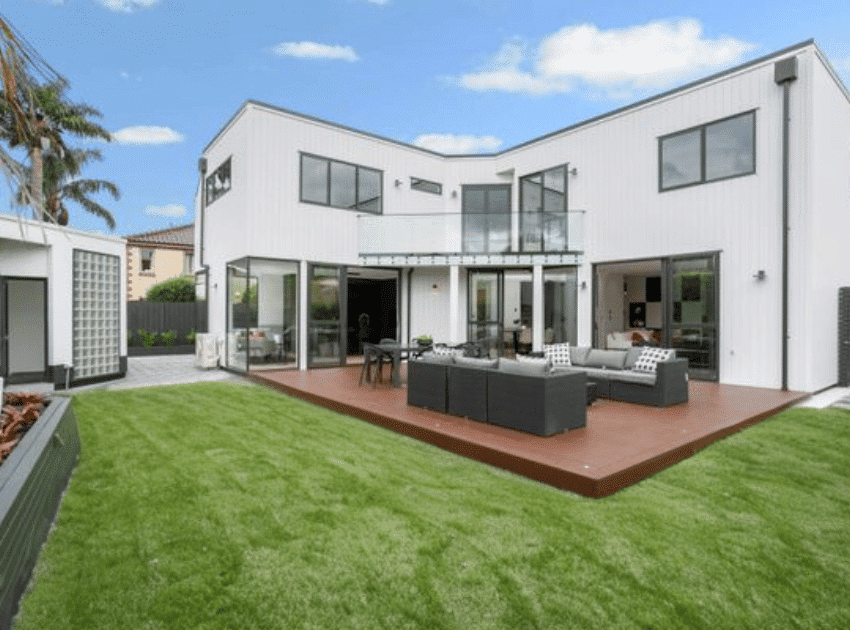
House recladding in Auckland in 2026 typically costs $150,000 – $500,000 for a full job, depending on house size, the condition of the framing underneath, and the cladding material you replace with. A standard 200m² timber-framed home with no structural damage starts around $150K. A two-storey monolithic-plaster reclad with remedial timberwork sits in the $330K – $500K range. Single-storey or partial reclads can be done from $135K. Building consent is required for almost every full reclad, and the work must be carried out or supervised by a Licensed Building Practitioner (LBP).
This guide breaks down the real cost ranges, the cladding material choices that affect your budget and resale value, what triggers a reclad, the consent process, the timeline, and the practical decisions that make or break a recladding project. Updated for 2026 Auckland market rates.
What recladding actually means
Recladding is the removal of a house’s external cladding system and replacement with new materials. It’s not a paint job, and it’s not a partial repair — those are separate, cheaper interventions. A full reclad strips the house back to the framing, exposes any moisture or rot damage, and replaces both the cladding and (in any modern reclad) the wall framing system underneath with a drained cavity.
FREE ESTIMATE
What Will Your Renovation Cost?
Get a realistic cost estimate based on your scope — no obligation.
Get Your Free Estimate →Two scenarios drive most Auckland reclads:
- Weathertightness failure. Visible signs of water damage, leaks, internal mould, or rotting framing — typically in monolithic-plaster (EIFS) homes built 1990–2004 with no drainage cavity. The “leaky home” category.
- Modernisation and de-risking. The cladding still works, but it looks dated, performs poorly thermally, or carries a “plaster home” stigma that affects resale. Common in 1990s and early 2000s monolithic homes that are dry but ageing.
The University of Auckland’s research is worth knowing here: formerly leaky homes reclad in weatherboard sell for roughly the same price as never-affected properties. Homes reclad in new monolithic cladding still attract a discount of around 6%. Unrepaired monolithic homes sell for approximately 9% less. The choice of replacement cladding has a real, measurable resale impact.
House recladding costs in Auckland (2026)
| House type | Typical reclad cost range | Timeline |
|---|---|---|
| Single-storey, weatherboard, no damage | $135,000 – $200,000 | 3 – 5 months |
| Single-storey, monolithic, minor damage | $165,000 – $260,000 | 4 – 6 months |
| Two-storey, weatherboard, sound framing | $200,000 – $320,000 | 4 – 7 months |
| Two-storey monolithic, average remediation | $330,000 – $400,000 | 5 – 8 months |
| Two-storey monolithic, major rot + redesign | $400,000 – $500,000+ | 6 – 10 months |
| Partial reclad (worst-affected sides only) | $50,000 – $130,000 | 2 – 4 months |
These are full-package numbers — they include strip-out, scaffold and weather protection, framing remediation where needed, new drainage cavity, new cladding, new joinery flashings, paint and finish. They typically do NOT include new joinery (replacing windows and doors usually adds $25K–$60K), interior repaint and reinstatement after the work, or any internal renovations done at the same time.
Common additional costs
- Remedial design and engineering: $10,000 – $25,000
- Building consent fees: $5,000 – $15,000 depending on declared project value
- Asbestos testing (pre-2000 homes) and removal if required: $2,000 – $20,000+
- New double-glazed joinery (typical replacement during reclad): $25,000 – $60,000
- Insulation upgrade (recommended while walls are open): $5,000 – $15,000
- Interior reinstatement: paint, skirtings, architraves, sometimes new linings where moisture ingress damaged plasterboard
- Roof works: if the original roof flashings or eaves were part of the moisture problem, expect $20K – $80K for roof-related work
- Decks and balconies: if leaky balconies are part of the original weathertightness issue, full replacement of deck membranes and substrate adds $15K – $50K
Budget at least 20% contingency for any reclad. Hidden rot behind the cladding is the rule, not the exception — once the cladding comes off, scope can expand quickly.
Cladding material choices and their costs
The cladding material you replace with affects both upfront cost and long-term maintenance. Auckland’s coastal climate, UV exposure, and humidity favour systems that handle moisture and salt well.
| Cladding material | Installed cost (per m²) | Maintenance | Best for |
|---|---|---|---|
| Fibre cement weatherboard (James Hardie) | $200 – $300 | Repaint every 10 years | Most Auckland homes — durable, low maintenance, looks like timber |
| Timber bevel-back weatherboard | $250 – $280 | Repaint or stain every 5–8 years | Classic villa look, character homes |
| Cedar weatherboard | $300 – $400 | Stain every 8–10 years | Premium look, Mt Eden / Remuera character properties |
| Brick veneer | $230 – $300 | Minimal — occasional wash | Lowest long-term cost, thermal mass benefits |
| Metal longrun (Colorsteel) | $200 – $350 | Effectively zero for 20+ years | Coastal areas, modern designs, low maintenance |
| Modern plaster (cavity system) | $280 – $400 | Repaint every 10–12 years, regular inspection | Contemporary architectural look — but resale discount applies |
| Stone or schist veneer | $400 – $600+ | Effectively zero | Premium feature walls, architectural homes |
The big strategic call: weatherboard or brick reclad recovers full market value; new monolithic plaster reclad still carries a 6% resale discount according to University of Auckland research. For most plaster homes being reclad, switching to fibre cement weatherboard is the safer choice for resale.
Why so many Auckland homes need recladding (the leaky home story)
If your house was built between 1990 and 2004 and has monolithic plaster cladding, you’re in the highest-risk category for weathertightness failure. The reason traces back to a perfect storm of building decisions made during the construction boom of that era:
- Untreated kiln-dried framing. A change in the Building Code allowed untreated timber framing — and any moisture that got through the cladding had nothing to stop it rotting the structure.
- Direct-fix monolithic plaster (no cavity). The plaster was applied straight to the building wrap with no drainage cavity, so any moisture that got behind it had no way to dry out.
- Mediterranean architectural style. Flat roofs, no eaves, internal decks, parapet walls, complex junctions — every weatherboard’s worst nightmare.
- Light-touch inspection regime. Council oversight was reduced in the early 1990s. Many problem details slipped through.
The Building Code clause E2 was overhauled in the mid-2000s to require cavity-backed cladding systems for almost all situations. Modern monolithic cladding, properly installed over a drainage cavity, is genuinely watertight — but the stigma from the original failures has stuck around. That’s why so many sound monolithic homes are still being reclad: not because they’re leaking, but because the next buyer will assume they are.
Signs your house might need recladding
Visible warning signs that warrant a professional weathertightness inspection:
- Inside: musty smells, peeling paint on interior walls, brown staining around windows or at floor junctions, mould patches that return after cleaning, condensation that’s heavier than a single-glazed window can explain
- Outside: hairline cracks in plaster, soft spots in the cladding (especially around windows, doors, and at the bottom of walls), cracked or failed silicone seals, paint flaking off cladding, rust marks below balcony or deck junctions
- Roof and decks: ponding on flat roofs, deteriorating membrane on internal decks, soft floors near deck doors, signs of water staining on the underside of roof eaves
- Health signals: family members with worsening allergies, asthma, or persistent respiratory issues — chronic mould exposure is a real risk in leaky homes
If you spot more than one of these, get a moisture and weathertightness inspection ($800 – $2,500 typical). It uses a moisture meter and thermal imaging to find water issues before they become visible damage. Catching it early can mean the difference between targeted repair ($30K – $80K) and a full reclad ($300K+).
Every guide you need for a successful renovation
Checklists, builder questions and insider knowledge — all free, written by a Master Builder with 200+ completed Auckland renovations.
The Auckland recladding process step by step
- Weathertightness assessment. A qualified building surveyor or building consultant inspects the house, reports on moisture levels, identifies damage, and recommends the scope (partial vs full reclad).
- Remedial design. An LBP designer (or architect) draws up plans for the reclad: cladding system choice, drainage cavity detail, flashings, junction details, roof and joinery interactions. Engineer input where structural framing remediation is needed.
- Building consent application. Plans submitted to Auckland Council. Statutory processing is 20 working days, but RFIs (requests for information) commonly stretch that to 8–12 weeks for a reclad. Pre-application meetings with council are worth the time.
- Scaffold and weather protection. Full scaffold around the building, plus a temporary roof or shrink-wrap. This is the moment you can’t go back — once the cladding comes off, the house must stay watertight via the wrap and scaffold until the new cladding is on.
- Cladding strip-out. Existing cladding removed carefully. Asbestos testing is mandatory before any work on pre-2000 homes; if present, abatement adds time and cost.
- Framing inspection and remediation. Engineer or building surveyor inspects the now-exposed framing. Rotten or damaged timber is replaced. This is where scope creep happens — until the cladding is off, no one can be sure how much framing damage exists.
- Building wrap and cavity battens. New building wrap installed, then cavity battens (typically 20mm) create the drained, ventilated cavity that modern E2 requires.
- New joinery (if replacing). Best done now — joinery is much easier to install when the cladding is off.
- Cladding installation and flashings. New cladding fixed to the cavity battens, with flashings at every junction (window heads, sills, corners, roof junctions). The flashing detail is where most reclad failures happen — get this right.
- Council inspections. Typically 2–4 inspections during the build: pre-line, pre-cladding (cavity batten inspection), post-cladding, and final.
- Paint and finishing. Cladding painted to final colour. Joinery finishes. Internal reinstatement.
- Code Compliance Certificate (CCC). Council reviews all documentation and inspection records, issues CCC. This is the document future buyers will look for — it confirms the work was done to code.
For a real-world example, see our case study on the Epsom recladding and second-storey extension project — full strip and reclad combined with adding a second floor.
Recladding and building consent
Full house recladding always requires a building consent in New Zealand. The work is classified as Restricted Building Work (RBW) under the Building Act because it directly affects the building envelope and weathertightness — exactly the kind of work the consent system exists to oversee.
What this means in practice:
- An LBP designer (Design 1 minimum for single-storey, Design 2 for two-storey) must design the reclad and produce the consent drawings
- An LBP builder (Carpentry licence) must carry out or supervise the structural and weathertight work
- Records of Work (Form 2A for design, Form 6A for build) must be lodged with council at completion
- Code Compliance Certificate is issued at the end — this is what protects you (and future buyers, lenders, and insurers)
- The new granny flat consent exemption doesn’t help here — recladding an existing house is not covered by Schedule 1A
See our Auckland Council building consent guide for the full consent process detail.
Smart decisions that save real money on a reclad
- Combine the reclad with other planned work. Adding a second storey, extending sideways, or doing kitchen/bathroom renovations is materially cheaper when done at the same time as the reclad. The scaffold is up; the consent is in; the disruption is happening anyway.
- Choose weatherboard or brick over new plaster. The 6% resale discount on new monolithic cladding usually outweighs any per-m² saving. On a $1.5M home, that’s $90K in resale value.
- Upgrade insulation while the walls are open. Adding R2.6+ wall insulation costs $5K–$15K extra during a reclad and pays back in heating costs and comfort. Doing it after is many times more expensive.
- Replace single-glazed joinery during the reclad. Window installation is much easier with the cladding off. The double-glazing upgrade adds $25K–$60K but transforms thermal performance.
- Fixed-price contract, not charge-up. A design-and-build company that can give you a fixed price after the design and a thorough pre-strip inspection protects you from “scope creep” once the cladding is off.
- Hold a 20% contingency. Standard advice for reclads — hidden damage is the norm. Better to release the contingency at the end than scramble for funds mid-build.
- Get a Master Build guarantee. The 10-year structural and weathertight guarantee is what restores buyer confidence in a previously-suspect home.
House recladding FAQs
How much does it cost to reclad a house in Auckland in 2026?
House recladding in Auckland in 2026 typically costs $150,000 – $500,000 for a full job. A standard 200m² single-storey timber-framed home with no structural damage starts around $150K. A two-storey monolithic-plaster reclad with framing remediation typically sits at $330K – $400K, and complex jobs with major rot or redesign can push past $500K. Partial reclads (worst-affected sides only) can be done from $50K.
Do I need building consent to reclad my house?
Yes, almost always. Full house recladding is Restricted Building Work under the Building Act 2004 because it affects the building envelope and weathertightness. An LBP designer must produce the consent drawings, an LBP builder must carry out or supervise the work, and a Code Compliance Certificate must be issued at the end. The only exception is very minor patch repairs that don’t touch the wall lining or framing.
How long does a full house reclad take?
Plan on 3 – 10 months from kick-off to Code Compliance Certificate. The breakdown: 4–8 weeks for design and consent drawings, 8–12 weeks for council consent processing (often longer for monolithic-to-cavity recladding due to RFIs), 8–24 weeks on-site construction depending on size and remediation scope, then 2–4 weeks for CCC. Single-storey timber-framed homes finish at the shorter end; two-storey monolithic reclads with major remediation finish at the longer end.
What’s the best cladding material to reclad with in Auckland?
For most Auckland homes, fibre cement weatherboard (James Hardie) is the best balance of cost ($200–$300/m² installed), durability, and resale value. It’s tough against coastal salt, requires repainting only every 10 years, and avoids the resale stigma of monolithic plaster. Cedar weatherboard suits character villas in Mt Eden or Remuera ($300–$400/m²). Brick veneer ($230–$300/m²) is the lowest long-term cost. Metal longrun is excellent for coastal areas and modern designs.
Does recladding my house increase its resale value?
Yes, especially if you reclad with weatherboard. University of Auckland research found that formerly leaky homes reclad in weatherboard sell for roughly the same price as never-affected properties. Homes reclad in new monolithic cladding still attract a discount of around 6%. Unrepaired monolithic homes sell for approximately 9% less. The cladding material choice has a real, measurable resale impact.
How do I know if my house has a leaky home problem?
Warning signs include musty smells inside, brown staining around windows, peeling interior paint, mould that returns after cleaning, hairline cracks in plaster cladding, soft spots in the cladding (especially at the base of walls and around windows), and failed silicone seals. Homes built 1990–2004 with monolithic plaster cladding, flat roofs, no eaves, internal decks, or Mediterranean styling are the highest-risk category. Get a weathertightness inspection ($800–$2,500) if you spot multiple warning signs.
Can I just partially reclad the worst-affected sides?
Yes, partial reclads are possible and typically cost $50,000–$130,000. They make sense when only one or two walls (often the prevailing-weather walls) show damage, and the rest of the cladding is in good condition. The trade-off: the new cladding may not perfectly match the existing, and future buyers can see the “patched” history. Full reclads usually deliver better resale outcomes despite the higher upfront cost.
Is asbestos testing required before a reclad?
Yes for any home built before 2000. Cement-based plaster claddings and some flashings from that era can contain asbestos fibres, and disturbing them without proper precautions is hazardous. Asbestos testing costs $300–$800 typical, with removal (if positive) adding $2,000–$20,000+ depending on quantity and access. Always factor this into a pre-2000 reclad budget.
Should I replace windows and doors during the reclad?
Almost always yes. New double-glazed joinery installs much more easily when the cladding is off — there’s no need to disturb cladding flashings or risk re-leaks at junctions. The upgrade adds $25,000–$60,000 typically but transforms thermal performance, sound insulation, and security. It’s significantly cheaper than doing it as a separate project later.
Does AVR do recladding work in Auckland?
Yes. AVR is a Registered Master Builder and LBP-certified for both design and build. We handle the entire recladding process — weathertightness assessment, remedial design, consent application, scaffold and weather protection, strip-out and remediation, new cladding installation, and CCC. We specialise in combining recladding with other renovation work (second storeys, extensions, kitchen and bathroom renovations) to maximise the value of the scaffold-up phase. See our Epsom recladding + second storey case study for an example.
Related guides
- Renovating Through an Auckland Winter — why winter renovations work, planning around weather
- Auckland Renovation Costs Hub 2026 — master cost overview across all renovation types
- Auckland Council Building Consent Guide — the full consent process for reclads and renovations.
- Auckland Home Renovation Costs 2026 — cost context for the broader renovation project.
- Adding a Second Storey to Your Auckland Home — the most common reclad combination.
- Architect vs Architectural Designer vs Draftsman — who you need on the design team.
- Case study: Epsom recladding + second storey extension — full reclad combined with a second floor addition.
READY TO START YOUR RENOVATION?
Talk to an AVR specialist — no obligation, no sales pitch.
We have completed 200+ Auckland renovations. Fixed price. Master Builder Guarantee. We will give you a straight answer about your project.