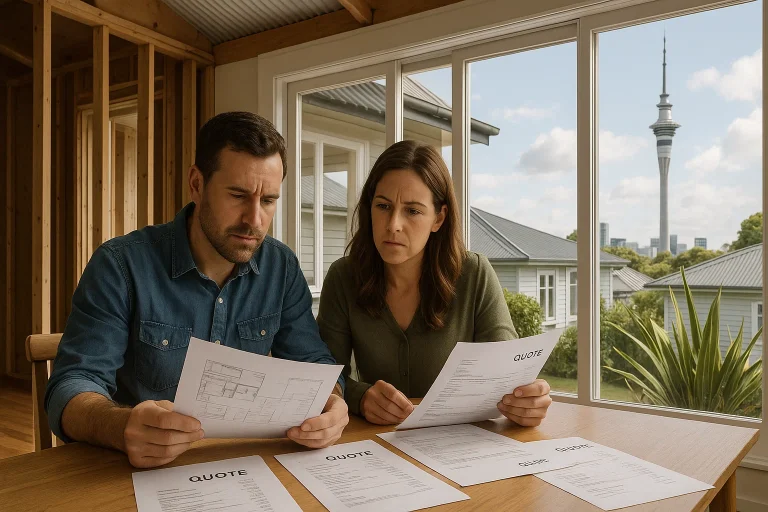

Most homeowners sign a renovation contract without reading it properly. Some sign without reading it at all. This is how people end up in disputes that cost them tens of thousands of dollars and months of stress.
A renovation contract is the single most important document in your project. Here is what it must include — and what should make you walk away.
1. A Detailed Scope of Work
The scope of work defines exactly what is being built, to what specification, using which materials. A vague scope is the #1 cause of renovation disputes in New Zealand.
FREE DOWNLOAD
25 Questions to Ask Your Builder Before You Sign Anything
The checklist that separates reliable renovators from costly mistakes.
Get Free Guide →Good scopes include: every room, every trade, every finish specified by brand and model number where applicable, and an explicit statement of what is excluded from the contract. If something is not in the scope, the builder is not obligated to do it — and they will charge a variation rate to include it later.
What to check: Can you cross-reference the scope against your brief and confirm every item is included? If the scope is vague (“kitchen renovation as discussed”), get it rewritten before you sign.
2. A Fixed Price (or a Clear Cost-Plus Framework)
The contract must state clearly whether this is a fixed-price contract or a cost-plus (charge-up) contract. These are fundamentally different arrangements.
Fixed price: You pay the agreed amount regardless of what it actually costs the builder to complete the work. Budget certainty for you; risk on the builder.
Cost-plus: You pay the builder’s actual costs plus a margin. No budget certainty. The builder has limited financial incentive to be efficient.
For most Auckland renovation projects, a fixed-price contract is strongly preferable. If a builder insists on cost-plus, ask why — and get a detailed explanation of the ceiling cost and how overruns are managed.
3. A Payment Schedule Tied to Milestones
Your payment schedule must be tied to verified completion milestones — not to dates on a calendar. If a payment falls due on a date regardless of progress, you lose your leverage to hold the builder accountable.
A standard milestone-based payment schedule for a full renovation looks like:
- 10% deposit on signing (maximum — do not pay more)
- 20% on completion of demolition and rough-in
- 25% on completion of framing, waterproofing inspection passed
- 25% on practical completion of linings and joinery
- 15% on practical completion
- 5% retained for 12 months (defects liability)
Never pay the final invoice in full until the Code Compliance Certificate is issued and you have completed a defects walkthrough.
4. A Variation Process
Variations are changes to the agreed scope. Every renovation has them. The contract must specify that:
- All variations are quoted in writing before work proceeds
- You must sign written approval before the variation work starts
- Variation rates (hourly, per unit) are specified in the contract
If a builder starts work and presents you with a variation invoice afterwards, you have no contractual basis to dispute the cost. The process must be written into the contract up front.
5. A Project Programme
The contract should include a project programme — or reference a programme to be provided within 5 working days of signing. This sets out the timeline, key milestones and the sequence of trades.
The programme is your reference point if the project falls behind schedule. Without it, there is no agreed baseline to measure against. A builder who is unwilling to provide a programme is a builder who does not want to be held to a timeline.
Every guide you need for a successful renovation
Checklists, builder questions and insider knowledge — all free, written by a Master Builder with 200+ completed Auckland renovations.
6. Consent Responsibilities
The contract must clearly state who is responsible for applying for and obtaining building consent — you or the builder. It should also specify who pays consent fees (typically the homeowner, but sometimes included in the build price).
If the builder is the consent applicant (as they typically are in a design-and-build contract), the contract should specify the expected consent timeline and what happens if consent is delayed.
7. Insurance Requirements
The contract should specify that the builder holds:
- Public liability insurance (minimum $2M — preferably $5M+)
- Contractor’s all-risk (contract works) insurance
- Employer’s liability insurance
And you should hold: a home and contents policy that covers construction works (check with your insurer — standard policies sometimes exclude this).
8. A Defects Liability Period
The contract must specify a defects liability period — the period after practical completion during which the builder is required to remedy defects at their own cost. Standard in New Zealand is 12 months.
During this period, document every defect in writing as soon as it appears, and request remediation in writing. Keep all correspondence on file.
9. Dispute Resolution Process
The contract should specify what happens if you and the builder cannot agree. Standard NZ renovation contracts reference adjudication under the Construction Contracts Act 2002 — a faster and cheaper alternative to court proceedings.
A builder who refuses to include a dispute resolution clause in the contract is a builder who plans to make disputes as difficult as possible for you to resolve.
10. A Workmanship Warranty
Separate from product warranties (which come from manufacturers), a workmanship warranty covers the builder’s own work. This should be a minimum of 12 months, and ideally backed by a Master Builder Guarantee — which also covers defects caused by faulty workmanship, incomplete work if the builder cannot complete, and builder insolvency.
5 Red Flags That Mean Walk Away
These contract terms and behaviours should make you reconsider before signing:
- Deposit over 10%. A large upfront deposit means the builder is using your money to fund other projects. It also removes your financial leverage.
- No written variation process. If the contract does not require written sign-off before variation work proceeds, you have no cost control.
- Payments tied to dates, not milestones. You should only pay for work that has been completed and verified.
- Vague scope with verbal agreements. If the builder says “don’t worry, we’ll sort it out,” get it in writing or do not sign.
- No insurance documentation. Any builder who cannot produce current insurance certificates before signing should not be on your site.
Before You Sign: Use Our Checklist
We have put together a free guide with 25 specific questions to ask any builder before signing a contract — including what good answers look like and what red flags sound like.
Download it free from our resource centre — no obligation, no sales call required.
If you are working with Add Value Renovations, every contract we issue is a Master Builders standard contract. We are happy to walk you through every clause before you sign.
Related guides
Renovation contracts and the choosing process:
- 12 Questions to Ask Before Hiring a Renovation Builder — builder selection, credentials, red flags
- How to Finance a Major Renovation in NZ — finance options, banks, construction loans, mortgage top-ups
- The Truth About Multiple Quotes — before the contract stage.
- Fixed Price vs Charge-Up — which pricing model your contract uses.
- 6 Questions to Ask Your Builder — pre-contract due diligence.
- 10 Steps to Plan Your Renovation — contract sits in step 7-8.
- Renovation Pitfalls to Avoid — contract-related pitfalls.
READY TO START YOUR RENOVATION?
Talk to an AVR specialist — no obligation, no sales pitch.
We have completed 200+ Auckland renovations. Fixed price. Master Builder Guarantee. We will give you a straight answer about your project.