Auckland · 2026 Edition
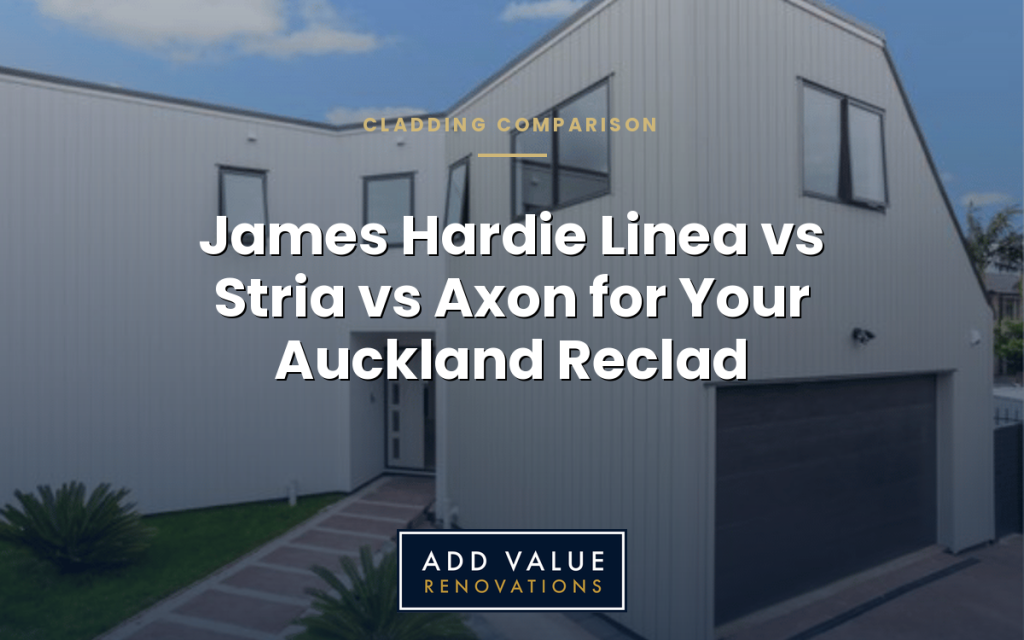
James Hardie Cladding Auckland: Linea vs Stria vs Axon (Which for Your Reclad)

James Hardie fibre cement is now the most popular reclad choice on Auckland homes — partly because it’s genuinely engineered for our climate, and partly because the brand is the only fibre cement manufacturer most Auckland clients recognise. But Hardie makes several different cladding systems, and picking the right profile for your home is the difference between a result you love and one that looks dated within five years.
- Why James Hardie dominates the Auckland reclad market
- Linea Weatherboard
- Stria Cladding
- Axon Panel
- Hardie Architectural Panel
- Side-by-side comparison
- Choosing the right Hardie product for your home
- What the choice means for your reclad cost
- Other fibre cement products worth considering
- The bottom line
- Frequently asked questions
Why James Hardie dominates the Auckland reclad market
Three reasons:
- Pre-finished and pre-primed factory finishes. Hardie boards arrive on site already primed, with consistent edges and uniform thickness. Site installation is faster than cedar weatherboard, and the painted finish lasts longer than site-applied primers.
- Fire, pest, and rot resistance. Fibre cement won’t burn, won’t rot, and termites won’t eat it. For Auckland clients coming out of a leaky plaster situation, this is psychologically important — the new cladding is biologically inert.
- Building Code compliance and installation track record. Hardie’s products have detailed installation manuals, Auckland Council pre-approval, and 20+ years of real-world Auckland data. Builders trust them because they know how to install them correctly.
Linea Weatherboard
What it looks like
Horizontal weatherboard profile, 180mm or 230mm exposed face, classic bevelled weatherboard look. Visually similar to traditional cedar bevel-back weatherboard at distance, but the boards are perfectly uniform up close.
Best for
Villas, bungalows, character homes, and family homes where you want a traditional weatherboard look without the maintenance of cedar. By a wide margin the most-installed Hardie product on Auckland reclads.
Cost
Materials around $55–$75/m² depending on board width and finish. Total installed cost (including framing prep, building wrap, battens, fasteners, install labour) typically sits at $230–$340/m² on a reclad.
Watch out for
Linea relies on tight detailing at horizontal joins. Cheap installers leave gaps too wide or run boards out of plumb across the elevation, which the eye picks up immediately. The board itself is forgiving; the install is what makes or breaks the look.
Stria Cladding
What it looks like
Horizontal flush-jointed panel system with a clean expressed shadow line between panels. Modern, contemporary aesthetic. Comes in 405mm and 305mm coverage widths.
Best for
Modern homes, contemporary architectural styles, and feature elevations on otherwise-weatherboard homes. Often used as the dominant cladding on 2000s-style homes or as a feature on entries and gable ends.
Cost
Materials around $65–$85/m². Total installed cost typically $250–$370/m². Slightly more expensive than Linea because of the precision required at panel joints.
Watch out for
Stria’s expressed shadow lines look great when installed flat and true, but show every framing irregularity behind. The framing repair work on the reclad matters more with Stria than with Linea — bowed studs translate directly into wavy panel lines.
Axon Panel
What it looks like
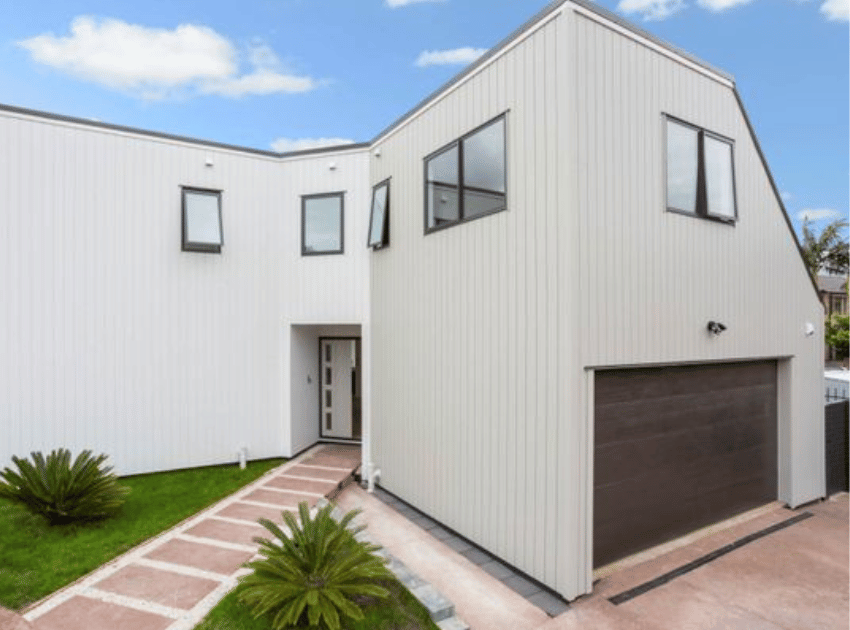
Vertical groove panel system, with grooves typically at 133mm or 400mm centres. Strong vertical emphasis, modern and refined look. Often used to add height to single-storey homes or to create a feature look on entries.
Best for
Modern coastal homes, architecturally designed contemporary builds, and feature elevations where vertical line work fits the design. Less common than Linea on Auckland reclads but increasingly chosen on the front elevation of mid-2000s home reclads.
Cost
Materials around $70–$95/m². Total installed cost typically $260–$390/m². Vertical board installation is slightly slower than horizontal, particularly around openings.
Watch out for
Vertical cladding hides nothing at penetrations. Window flashings need to be detailed to match the groove spacing. Cheaper installations cut flashings to suit and end up with offset grooves that look like a mistake.
Hardie Architectural Panel
What it looks like
Large-format flat panels (typically 1200mm wide) with minimal visible jointing. Used to create flush, monolithic-looking facades without the weathertight risk of traditional monolithic plaster.
Best for
Clients who want to keep the “plaster home” aesthetic without recladding back into actual plaster. Modern architectural homes. Feature walls on otherwise weatherboard or board-and-batten facades.
Cost
Materials around $80–$110/m². Total installed cost typically $300–$430/m². The most expensive of the four because the panels are larger, heavier, and require more precise detailing at edges.
Watch out for
Architectural Panel needs a perfectly plumb and true framing substrate. The flush look is unforgiving of framing irregularity. Best paired with completely new framing rather than repair-and-retain framing.
Buying or owning a plaster home?
Get the reclad number before you commit — $99 incl GST, credited if you build.
A 12-page Recladding Cost Plan built from your council property file and inspection reports: the number, the range either side of it, and the one survey worth paying for before you go unconditional. Five working days, no site visit needed.
Order a Recladding Cost Plan →Side-by-side comparison
Choosing the right Hardie product for your home
The single biggest factor is the architectural style of the home itself. Trying to retro-fit a modern Stria or Axon look onto a 1920s bungalow rarely works — the proportions, window framing, and roof pitch fight the modern cladding. Conversely, Linea on a 2010s contemporary home can look fussy and dated.
A simple rule of thumb:
- Pre-1960s character homes: Linea Weatherboard, sometimes with a feature panel in Architectural Panel on a chimney or gable.
- 1960s–1990s family homes: Linea is the safe default; Stria works on contemporary remodels.
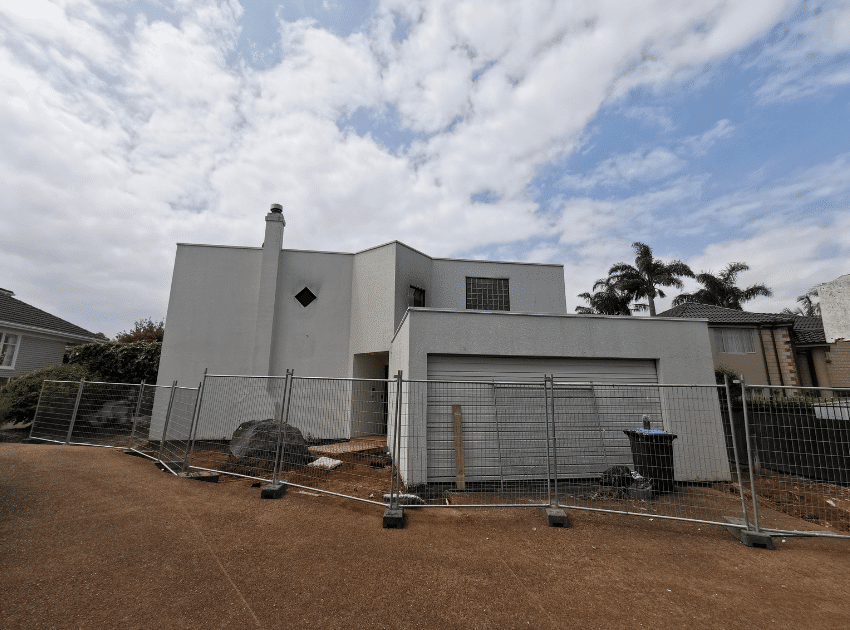
- 1990s–2000s plaster homes recladded: Architectural Panel if you want to keep the plaster-aesthetic; Linea if you want to shift to weatherboard for stronger resale; Stria for a contemporary update.
- Modern architectural homes: Stria, Axon, or Architectural Panel depending on the original design intent.
- Mixed material designs: Linea or Stria as the primary, with cedar or Architectural Panel as feature accents.
For homes where the existing look is generic 1990s plaster and the architecture doesn’t commit strongly to any style, a Linea reclad almost always delivers the strongest resale uplift. The University of Auckland resale research consistently shows weatherboard-recladded homes sell at price parity with never-leaky properties, where new monolithic-look reclads (including Architectural Panel) still attract a slight discount.
What the choice means for your reclad cost
The headline materials cost differences between Hardie products look small (a few dollars per square metre) but they compound across a full home. On a 200m² wall area:
- Linea materials: ~$13,000
- Stria materials: ~$15,000
- Axon materials: ~$16,500
- Architectural Panel materials: ~$19,000
Install labour difference between the four products is usually $3,000–$8,000 on a full reclad. So total installed cost difference between the cheapest (Linea) and most expensive (Architectural Panel) Hardie option on a typical Auckland reclad runs about $9,000–$15,000.
For full Auckland reclad cost ranges across all cladding systems, see our 2026 recladding cost guide.
Other fibre cement products worth considering
James Hardie is the dominant fibre cement brand in New Zealand but it’s not the only one. Palliside (PVC weatherboard) and Bowmac sheet products are used on some reclads, particularly where budget is constrained or specific design requirements suit. Bowers’ cedar and pre-finished composite weatherboards are popular when a heritage look matters and the budget allows. Our recladding service page walks through every cladding system we install.
The bottom line
For most Auckland reclads on family homes, Linea Weatherboard is the safe, well-installed, well-priced choice that delivers strong resale value and looks good across most architectural styles. Stria and Axon make sense on contemporary homes. Architectural Panel suits the niche case where the monolithic plaster look is desired without the underlying construction risk.
The most important decision isn’t which Hardie product to use — it’s whether your installer knows how to install it correctly. Hardie’s warranty is conditional on installation to their manual, and Auckland Council will check producer statements for compliance. Hire a Master Builder with documented Hardie installations rather than chasing the cheapest quote.
Frequently asked questions
Yes, and it’s common. Many modern Auckland reclads use Linea Weatherboard on the main walls with Stria or Architectural Panel as a feature on the entry, gable ends, or one elevation. The transition detailing is straightforward when planned at the design stage and looks intentional rather than mismatched.
Hardie publishes a 50-year warranty on its fibre cement products when installed in accordance with their manual. The paint finish lasts 10–12 years between recoats, depending on aspect and exposure. The board itself outlasts the paint by decades.
Modern Hardie products contain no asbestos and haven’t since the late 1980s. They’re made from cellulose fibres, Portland cement, sand, and water. Asbestos concerns relate to older fibrolite-style sheets manufactured before 1987. New Hardie boards are completely safe to handle, cut, and install — the only respiratory consideration is silica dust during cutting, which is managed with dust suppression and PPE.
Yes — with one practical caveat. Very dark colours (charcoal, black, deep navy) absorb heat and can put thermal stress on the boards, particularly on north-facing elevations. Hardie publishes a recommended Light Reflectance Value (LRV) limit for exterior paints on their products. Most colours within that LRV range are fine; the very darkest finishes need specific paint products designed for high heat absorption.
Hardie now offers a ColorPlus pre-finished range with factory-applied colour. The pre-finish lasts longer (15–25 years vs 10–12 for site-applied paint), is more uniform, and avoids site-painting issues. The trade-off is colour choice is more limited and any site-cut edges need careful sealing. For most reclads we recommend site-painted Hardie unless you want a specific ColorPlus colour or the budget supports the upgrade.
No — Auckland Council accepts any cladding product with a current BRANZ appraisal or equivalent compliance documentation. James Hardie products are well-known to Council inspectors, which usually means a smoother consent and inspection process, but other compliant products are equally acceptable.
Insider knowledge from 25+ years of Auckland renovations — the 7 things experienced renovators have learnt, condensed into a short guide you can read in 15 minutes. Save yourself the expensive lessons.
Plan your fibre cement reclad
Three ways to move forward — an instant estimate, a free on-site consultation, or our renovation ebook.
Get an instant estimate → Book a free consultation → Download the 7 Things ebook →