Auckland · 2026 Edition
Solid Core vs Hollow Core Doors: An Auckland Renovator’s Guide (2026)

Hollow core doors cost around $60–$81 a leaf in New Zealand. Solid core runs $164–$275. Pay the premium on bedrooms, bathrooms, home offices and media rooms, where you want quiet and a door that doesn’t feel like a stage prop. On wardrobes, linen cupboards and low-traffic openings, hollow core is the right answer — not a compromise.
This question comes up on nearly every renovation we price, usually late, usually after the kitchen has eaten the contingency. It’s worth answering properly, because doors are one of the few upgrades where a modest sum genuinely changes how a house feels day to day — and one of the few where spending everywhere is a waste.
REAL PROJECTS
See Real AVR Renovations in Auckland
200+ completed projects — kitchens, bathrooms, extensions and full home renovations.
Browse All Projects →
The 30-second answer
A hollow core door is two thin skins — usually pre-primed MDF — wrapped around a light frame and a honeycomb cardboard lattice. It is light, cheap, and mostly air. A solid core door uses the same skins over a dense core: particleboard, expanded polystyrene, or timber. It is heavier, quieter, tougher, and roughly three times the price.
Neither is the “correct” choice for a whole house. The useful question isn’t which door, it’s which openings. Sound and privacy matter at bedrooms and bathrooms. They don’t matter at a linen cupboard. Spend where you’ll notice.
What’s actually inside each door
New Zealand merchants stock more than the two options the internet argues about. Here’s what you’ll actually see on a PlaceMakers or Bunnings shelf:
| Core type | What it is | Where it belongs |
|---|---|---|
| Hollow core | Honeycomb cardboard lattice between pre-primed MDF skins, with a narrow solid block behind the handle | Wardrobes, linen and storage cupboards, low-traffic secondary rooms |
| EPS solid core | Expanded polystyrene core — a genuine solid core, but noticeably lighter than particleboard | The sensible middle: secondary bedrooms, hallways, anywhere you want a solid feel without the weight |
| MR particleboard solid core | Moisture-resistant particleboard — the heavy, dense option | Bathrooms, ensuites, laundries, main bedrooms, home offices, high-traffic doors |
| Solid timber | Traditional timber core or a solid stile-and-rail door | Character villas and bungalows, front-of-house doors where the look leads |
Core types and their intended use per Montage Doors NZ. Product naming varies between merchants — “solid core” on a price list can mean EPS or particleboard, and they don’t perform the same. Ask which one.
That EPS middle option is the one most overseas articles skip, and it’s genuinely useful. It gives you the thud and the impact resistance without the full weight penalty, which matters if you’re doing ten doors and hanging them yourself.
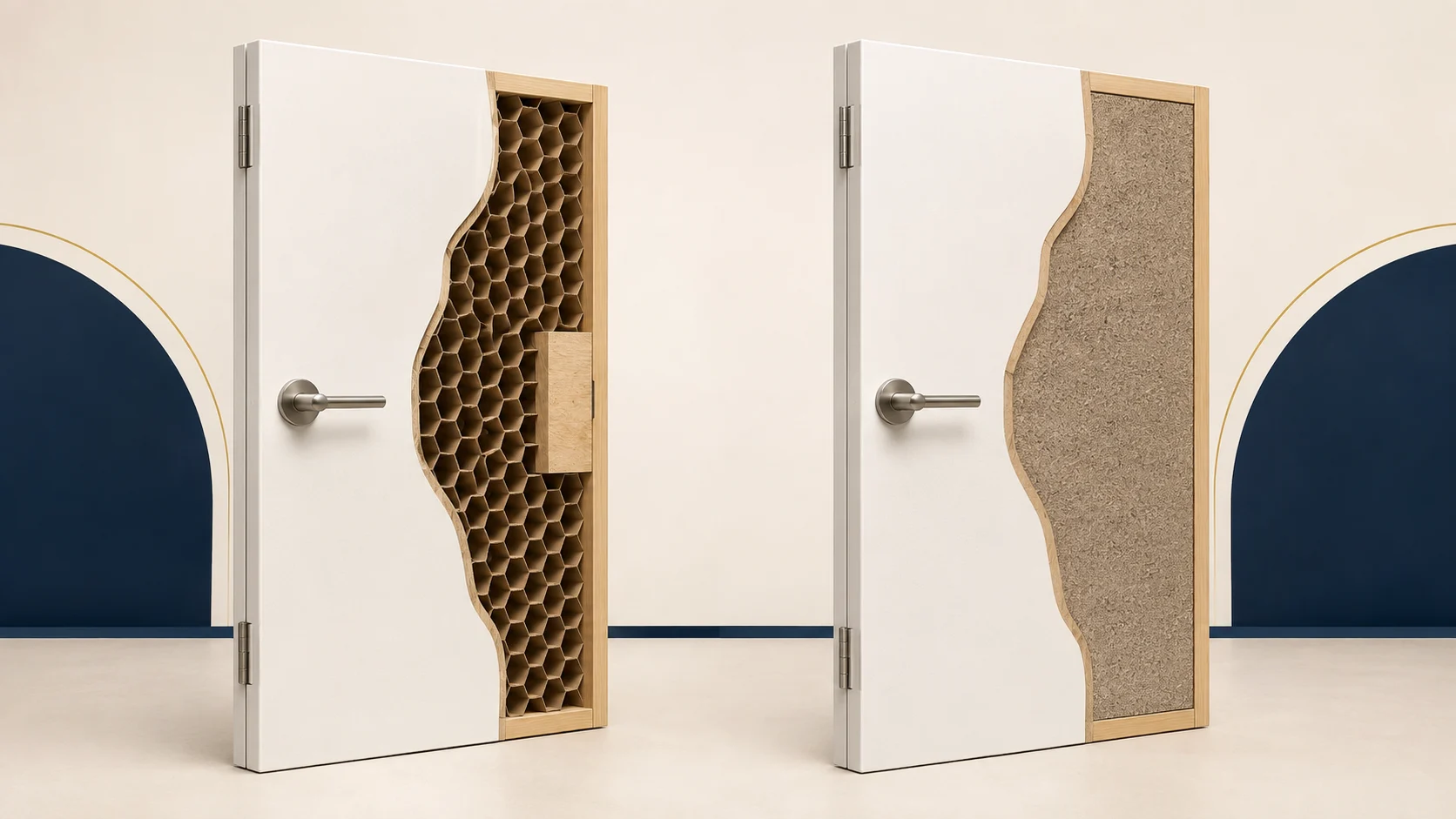
Thin MDF skins over a timber perimeter frame, with cardboard honeycomb through most of the leaf and a solid block behind the handle.
Thin MDF skins over a full particleboard core. The added mass improves impact resistance, feel and sound reduction.
How to tell what you’ve already got
Knock the middle of the door, then knock again about 100mm in from the handle. If the first knock sounds drummy and the second sounds solid, you have a hollow core door and you just found the lock block — a narrow strip of solid timber that exists purely so the handle has something to bite into. A solid core door sounds the same dull thud everywhere.
Sound: what a solid door will and won’t fix
This is the reason most people upgrade, so it’s worth being straight about what you get.
Sound reduction comes from mass. A hollow core door has almost none, which is why you can hear a conversation through one as if the door weren’t there. A solid core door has real mass and makes a real difference — but the number on the spec sheet is only achievable if the door is properly sealed.
Raven, whose acoustic seals are specified across New Zealand, rates a standard 40mm solid core timber door with matching perimeter and bottom seals at around Rw 30, at roughly 27 kg per square metre. On a 1980 × 810 leaf, that works out near 43 kg — genuinely a two-person lift. For comparison, purpose-built acoustic doorsets from NZ manufacturers such as Hallmark run from about STC 25 up to STC 43, and to STC 55 for interconnecting sets.
Two things follow from that. First, the gap does as much work as the slab. A 10mm undercut is an open window as far as sound is concerned. Fit seals, or accept that you’ve bought half the upgrade. Second, don’t shop on overseas numbers: US articles quote STC, New Zealand specifications quote Rw. The scales are close cousins but not interchangeable, and a figure lifted from a US blog tells you nothing reliable about what a NZ merchant will hand you.
Room by room
This is the section the question is really asking. Our default specification across an Auckland renovation:
| Opening | Our call | Why |
|---|---|---|
| Main bedroom | Solid core | The single highest-value door in the house. Sound and a sense of separation from the living areas. |
| Secondary bedrooms | Solid core, or EPS | Worth it with teenagers or shift workers. EPS is a fair compromise if the budget is tight. |
| Bathroom / ensuite | Solid core, MR core | Privacy is the point, and the moisture-resistant core handles the humidity swing. |
| Home office | Solid core | Since 2020 this is second only to the main bedroom. Video calls are unforgiving. |
| Media / rumpus room | Solid core + seals | Bass travels. Without seals you’ll hear it anyway — do both or don’t bother. |
| Laundry | Solid core | A washing machine on spin is exactly the noise a heavy door is good at. |
| Hallway / living | Either | Feel and consistency, not acoustics. Match whatever the adjacent doors are. |
| Wardrobe, linen, storage | Hollow core | Nothing to hear, nothing to hit. Solid core here is money set on fire. |
| Garage access | Solid core — but see below | Noise, and a door that gets treated roughly. Check whether a rated separation applies. |
The pattern most of our clients land on: solid core on bedrooms, bathrooms and the office; hollow core on cupboards; and the hallway doors matched to whichever is more visible. On a typical ten-door house that’s six or seven upgraded and three left alone.
What they cost in New Zealand
Real retail prices, checked September 2026. These are supply only — the bare leaf, before hinges, hardware, hanging or paint.
| Door | Size | Price (supply only) |
|---|---|---|
| Hume PCM Flush — hollow core (Bunnings NZ) | 1980 × 760 × 35mm | $59.75 |
| Hume Solidcore — solid core (Bunnings NZ) | 1980 × 760 × 35mm | $164 |
| Prime Coat Flush, honeycomb core (PlaceMakers) | 1980 × 810 × 35mm | $81.19 |
| Hume Solidcore (Bunnings NZ) | 1980 × 910 × 35mm | $174 |
| Hume Solidcore, tall leaf (Bunnings NZ) | 2400 × 810 × 35mm | $275 |
Indicative retail prices incl. GST, Bunnings NZ and PlaceMakers online, September 2026. Solid core leaves are typically special-order rather than shelf stock, so allow lead time. Prices move — treat these as a sense of scale, not a quote. We price doors properly at estimate stage.
The like-for-like comparison is the one that matters: at 1980 × 760, the same manufacturer’s hollow core leaf is $59.75 and the solid core leaf is $164. That’s a $104.25 premium per door, or about 2.7× the price.
Scale it up and the number stays manageable. Upgrade all ten doors in a typical house and you’re adding a little over $1,000 in materials. Upgrade the six that actually matter and it’s closer to $625. Set against a renovation budget, that is one of the cheapest quality-of-life improvements on the whole job — which is why it’s frustrating that it’s so often the thing that gets value-engineered out.

The costs that aren’t on the price tag
Weight has consequences, and they’re the part people don’t budget for:
- Three hinges, not two. We hang solid core on three heavier-duty hinges as standard. The extra mass concentrates load at the top fixing, and skipping the third hinge is why heavy doors start binding on the jamb after a season.
- The jamb has to be sound. A tired old jamb that was fine carrying 12kg may not stay plumb under 40kg. On older Auckland homes we check this before quoting a straight leaf swap.
- Cavity sliders are a different conversation. A cavity unit is engineered for a specific leaf weight. Swapping a hollow core slider for solid core can mean new rollers, or a new cavity, so decide before the linings go on.
- Hardware feels different. A heavy leaf on a cheap latch reads as cheap. If you’re upgrading the doors, upgrade the handles at the same time — the two are judged together.
- The slab is the smaller half. Once you add hinges, a handle set, hanging and two coats of paint, the door itself is usually not the largest line on that item.
The one nobody thinks about until it’s too late
You cannot hang anything on a hollow core door. Not a towel rail, not a full-length mirror, not an over-door hook rack, not a cat door. Outside the narrow lock block behind the handle there is nothing but cardboard for a screw to grab. Every year we get called to a bathroom where a towel rail has torn a hole clean through the skin. If a door has a job beyond opening and closing, it needs to be solid core.
Where the Building Code has a say
There’s a persistent belief that New Zealand requires a fire-rated or solid core door between an attached garage and the house. That rule is real — in the United States. It comes from the International Residential Code, and it does not apply here.
Under Acceptable Solution C/AS1, which covers houses and other sleeping-residential buildings, fire separations are required between household units. A garage that forms part of your own house sits inside your household unit, so for a standard stand-alone home there is generally no Code-mandated fire door on that opening. Where a garage is shared between household units, or your dwelling adjoins another unit — a townhouse, a duplex, a minor dwelling under the same roof — a rated fire separation does apply between them.
The distinction turns on how the units are arranged, not on the door, so confirm your own situation with your designer or the council rather than with a hardware catalogue. On any job where a separation is in play, we get it confirmed at design stage, not on site.
And the point worth carrying away regardless of your layout:
A solid core door is not a fire door
In New Zealand a fire door is a tested door set to NZS 4520 — the leaf, frame, seals and hardware certified together, self-closing and self-latching, with a rating written as an FRR such as −/30/30. A heavy door bought off the shelf is heavy, not rated. If a fire rating has been specified anywhere on your project, you need a certified doorset, and no amount of solid core substitutes for one.
What we specify, and why
Our default across an Auckland renovation is solid core to bedrooms, bathrooms, the office and the laundry; hollow core to wardrobes and storage; a moisture-resistant core anywhere wet; and acoustic seals wherever the client has told us that noise matters. Where budget is genuinely tight, EPS core on the secondary bedrooms is the compromise we’d make first, ahead of dropping back to hollow core.
The reason we push this at design stage rather than at selections is that two of the decisions above are hard to reverse later. Cavity sliders are sized for a leaf weight before the linings go on. Fire separations are a design question, not a finishing one. Both are cheap to get right early and expensive to revisit.
Questions we get asked
How do I tell if my door is hollow core or solid core?
Knock it. A hollow core door sounds drummy across the middle and solid only in a narrow band near the handle — that’s the lock block. A solid core door sounds the same dull thud everywhere. Weight is the other tell: you can carry a hollow core leaf one-handed up a flight of stairs, and you can’t do that with solid core.
Are solid core doors worth it in New Zealand?
On bedrooms, bathrooms, home offices and media rooms, yes. The supply premium is roughly $100 a leaf, and it buys real acoustic separation, a door that doesn’t flex when it shuts, and a leaf that will actually hold a hook or a towel rail. On wardrobes and linen cupboards, hollow core is the better buy.
Can you soundproof a hollow core door?
Not meaningfully. Perimeter and bottom seals will cut the leak around the edges, which helps a little, but the leaf itself has almost no mass — and mass is what stops sound. If quiet is the goal, replace the leaf with solid core and seal it. Sealing a light door is the cheap half of a job that only works when both halves are done.
What door should I use for a bathroom or ensuite?
Solid core with a moisture-resistant core — NZ suppliers list it as MR particleboard. It copes with the humidity swing better than a standard core and gives you the privacy you want on an ensuite. Ventilation still does the real work on moisture, so a good extract fan matters more than the door does.
Do I need a fire door between my garage and my house?
For a standard stand-alone house, generally no — C/AS1 requires fire separation between separate household units, and a garage that’s part of your own house sits inside yours. Where the garage is shared with another household unit, or your dwelling adjoins another unit, a rated separation does apply. Confirm your specific situation with your designer or the council.
Is a solid core door the same as a fire door?
No — and this is the most expensive confusion in the category. A fire door is a tested door set to NZS 4520: leaf, frame, seals and hardware certified together, self-closing and self-latching. A solid core door off the shelf is a heavy door, not a rated one.
Do solid core doors need special hinges?
They need more hinges and better ones. Three heavier-duty hinges rather than two, because the extra mass concentrates load at the top fixing. It’s a small cost, and skipping it is why heavy doors start to bind after a season.
Can you fit a solid core door into an existing frame?
Usually, if the jamb is sound and plumb. The leaf is swapped, hinge positions re-cut, and a third hinge added. It gets more involved with an old jamb that has moved, or with a cavity slider — a cavity unit is sized for a specific leaf weight, so a swap can mean new rollers or a new cavity.
What is a semi-solid door?
A middle option: skins over a frame more substantial than honeycomb but short of a full solid slab. The EPS core doors sold here fill a similar gap — better impact resistance and a more solid feel than hollow core, at less weight and cost than full particleboard. A reasonable compromise on secondary bedrooms.
Should I do the whole house at once?
If the doors are coming off anyway for painting or new architraves, yes — the labour is already committed and the marginal cost is just the leaves. If not, do the bedrooms and bathrooms first. Those are the doors you’ll notice.
Planning an Auckland renovation?
Doors are one line on a long list. Get a useful starting budget, then talk with our team about the full scope.
Get an instant estimate → Book a consultation → Or read the free guide: The Auckland Homeowner’s Renovation Guide
Sources: Current retail examples from Bunnings NZ hollow-core, Bunnings NZ solid-core and PlaceMakers internal doors, checked September 2026. Core types per Montage Doors NZ. Fire-separation scope per the current MBIE C/AS1. This guide is general information, not a Building Code determination; confirm Code requirements for your project with your designer or council.