
The Complete Renovation Checklist — ebook cover

The Complete Renovation Checklist — 50 Things to Confirm Before, During and After Your Build
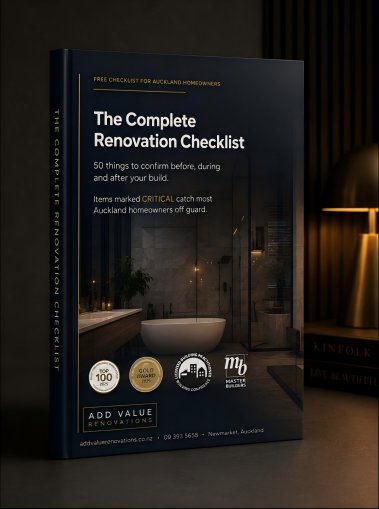
The Complete Renovation Checklist — 50 Things to Confirm Before, During and After Your Build
Free Download

The Complete Renovation Checklist — 50 Things to Confirm Before, During and After Your Build

Get the full 50-point checklist instantly — enter your details and it downloads straight to your device.

🔒 No spam. Your details are secure. Unsubscribe anytime.

✅ Your guide is ready!

⇓ Download Now

We’ve also emailed a copy to you.

Most Auckland homeowners start a renovation full of excitement. A few months in, that excitement turns to stress — missed inspections, variations creeping up, a builder who’s gone quiet, and a council certificate that’s taking forever.

The difference between a renovation that goes smoothly and one that doesn’t usually comes down to one thing: knowing what to check, and when. This checklist covers the 50 most critical confirmation points across the entire renovation journey.

Before Your Renovation Starts

The work you do before a single board is ripped out has more impact on your outcome than almost anything that happens on site. Here’s what to lock down:

Building Consent

For most structural work, kitchen extensions, bathroom additions or anything that changes the building envelope, you’ll need a building consent from Auckland Council. Confirm with your builder exactly what consents are required — and who is responsible for obtaining them. Don’t assume. Get it in writing in the contract.

Check the consent application has been lodged before work begins. Councils have 20 working days to process standard consents, but complex jobs can take longer. Starting without consent puts your code compliance certificate at risk later.

Your Builder’s Licence and Insurance

Any licensed building work (LBW) — which covers most structural, weathertightness and large-scale renovation work — must be carried out or supervised by a Licensed Building Practitioner (LBP). Verify your builder’s LBP licence on the MBIE register before signing.

Also confirm they carry public liability insurance and contract works insurance. Ask for certificates — a reputable builder will provide these without hesitation.

The Contract

A well-written contract protects both parties. At minimum, it should include: a fixed price or clear cost-plus terms, a detailed scope of works, a start and completion date, a payment schedule tied to milestones, a variation process, and a disputes process.

Master Builder contracts include a Master Build Guarantee — up to 10 years’ cover on workmanship and materials. This is one of the strongest protections available to New Zealand homeowners.

Scope and Specification

Before signing, make sure the scope of works matches exactly what you’ve discussed. Vague descriptions like “supply and install kitchen” leave gaps that become expensive variations later. The scope should specify brands, models, materials, finishes and quantities.

During the Build

Once the build starts, your job is to stay engaged without micromanaging. Regular communication and a few key inspections go a long way.

Progress Inspections

For larger renovations, you or a building inspector should inspect the work at key stages — typically before gib is fixed (to check framing, insulation and plumbing rough-in), and before tiling or flooring is laid over waterproofing membranes. These inspections are difficult or impossible to redo once concealed.

Variations

A variation is any change to the agreed scope. It could be your choice — you decide to upgrade the benchtop — or it could be unforeseen — the builder opens a wall and finds rotten framing. Either way, every variation should be documented and signed off before the work proceeds. Never accept verbal variations.

Keep a variations log. Track what was requested, the cost impact, and who authorised it. This prevents disputes at the end of the job.

Progress Payments

Your contract should tie payments to clearly defined milestones — foundation poured, framing complete, gib stopped, practical completion. Avoid paying ahead of milestones. A builder asking for money well in advance of completed work is a red flag.

Site Communication

Establish a weekly site meeting or update cadence at the start of the job. This keeps you informed without constant interruption to the builder’s team. Note any concerns in writing — text or email — rather than verbal conversations that can be forgotten.

At Completion

The end of a renovation is where many homeowners relax too early. Completion is when you need to be most thorough.

The Final Walkthrough

Walk through the completed work with your builder before making the final payment. Use a snag list — a written list of items that need attention before you consider the job finished. Common issues: paint touch-ups, alignment of doors and drawers, silicone finishing around wet areas, and tile grout.

Don’t sign off or make the final payment until snag items are resolved, or you have a written agreement for when they’ll be fixed.

Code Compliance Certificate (CCC)

If building consents were required, a Code Compliance Certificate must be issued by Auckland Council before the work is legally complete. Your builder should manage this process, including calling for final council inspections. Confirm the CCC is on its way before releasing final payment.

An unconsented renovation that should have had a consent will cause problems when you sell — and may affect your insurance cover.

Warranties and Manuals

Collect warranties for all materials, appliances and systems installed. Manuals for appliances, rangehoods, heating systems and ventilation should be handed over at completion. Keep these in a file — you’ll need them for future maintenance and when you sell.

Master Build Guarantee Registration

If your contract included a Master Build Guarantee, confirm it has been registered with Master Builders. You should receive a certificate. This is transferable to the next owner of your home — a genuine selling point.

Get the Full Checklist

The checklist above covers the key areas — but the full 50-point PDF goes deeper, with specific confirmation boxes for each stage, space for your own notes and dates, and a section for photos and inspection records.

The Complete Renovation Checklist — 50 Things to Confirm Before, During and After Your Build
Free Download

The Complete Renovation Checklist — 50 Things to Confirm Before, During and After Your Build

Download the full 50-point checklist — covers pre-build, during build, completion and post-renovation in one document.

🔒 No spam. Your details are secure. Unsubscribe anytime.

✅ Your guide is ready!

⇓ Download Now

We’ve also emailed a copy to you.

What Does an Auckland Home Renovation Cost?

Cost is the most searched topic in the renovation industry — and for good reason. Here are realistic Auckland ranges based on completed projects:

  • Kitchen renovation: $30,000 – $120,000+ (scope: cabinetry, benchtops, appliances, splashback, flooring)
  • Bathroom renovation: $20,000 – $60,000 (scope: waterproofing, tiling, fixtures, vanity)
  • Full home renovation: $150,000 – $500,000+ (scope: kitchen, bathrooms, living areas, structural work)
  • Home extension (ground floor): $120,000 – $300,000+ (scope: new living space, consent, foundation)
  • Second storey extension: $200,000 – $450,000+ (scope: structural engineering, new rooms, staircase)

These are broad ranges. The only way to get an accurate cost for your specific project is a fixed-price quote backed by a Quantity Surveyor. Add Value Renovations provides QS-backed fixed pricing on every project.

Renovation Checklist FAQ

Do I need a building consent for my Auckland renovation?

Most structural work, bathroom additions, kitchen extensions and any changes to the building envelope require a building consent from Auckland Council. Work like painting, re-carpeting or like-for-like fixture replacement generally doesn’t. Your builder should advise you upfront — if they can’t tell you clearly, that’s a red flag. Consent fees typically range from $2,000 to $8,000 depending on project scope.

What does a Code Compliance Certificate (CCC) cost and how long does it take?

Auckland Council charges around $500–$1,200 for a CCC inspection, depending on project complexity. Processing typically takes 10–20 working days after the final inspection. Never release your final payment until the CCC process is underway — it’s your legal confirmation that the work meets the building code.

What is a Master Build Guarantee and is it worth it?

The Master Build Guarantee provides up to 10 years of cover on workmanship and materials, is backed by Master Builders New Zealand, and transfers to the next owner when you sell — a genuine selling point. It’s worth it. Only registered Master Builders can offer it, so verify membership before you sign.

How much should I budget for renovation variations?

Industry experience suggests setting aside 10–15% of your contract value as a variation contingency. For a $200K renovation, that’s $20K–$30K. Unforeseen issues — rotten framing, outdated wiring, unexpected structural requirements — are common in Auckland’s older housing stock. Having contingency reduces stress significantly.

How long does a typical Auckland home renovation take?

A kitchen renovation typically takes 6–10 weeks on site. A full bathroom renovation takes 4–8 weeks. Full home renovations vary from 3 to 9 months depending on scope and consents. Building consent processing alone adds 4–8 weeks before work can start, so factor this into your timeline early.

About Add Value Renovations

Add Value Renovations is a Newmarket-based design-and-build renovation company with over 200 completed projects across Auckland. We’re Master Builders, LBP Licensed, and Gold Award winners for 2025. Every project includes a fixed price and a Master Build Guarantee.

If you’re planning a renovation and want to talk through your project, get in touch or call us on 09 393 5658.

Free Resources for Auckland Renovators

Every guide you need for a successful renovation

Checklists, builder questions and insider knowledge — all free, written by a Master Builder with 200+ completed Auckland renovations.

Browse Free Guides → 3 free guides  ·  Instant download